
Note
Go to the end to download the full example code.
Calculating the temperature and emission measure#
In this example, we will showcase how to use the filter method to calculate the temperature and emission measure of the X-ray Telescope (XRT) on Hinode.
import matplotlib.pyplot as plt
import sunpy.map
from astropy.visualization import ImageNormalize, LogStretch
from sunpy.net import Fido
from sunpy.net import attrs as a

from xrtpy.response import temperature_from_filter_ratio
To start, we will get XRT data via sunpy.
It is important to use images that same size and with the smallest time separation. Note that not all filter ratios produce good results.
query = Fido.search(
    a.Time("2011-01-28 01:31:55", "2011-01-28 01:32:05"), a.Instrument("xrt")
)
data_files = Fido.fetch(query)

# Retry any downloads that failed transiently (e.g., VSO/SDAC hiccups).
# Calling fetch on the previous result only re-attempts missing files.
for _ in range(3):
    if not data_files.errors:
        break
    data_files = Fido.fetch(data_files)

if len(data_files) < 2:
    raise RuntimeError(
        f"Expected 2 XRT files from VSO, got {len(data_files)}. "
        f"Download errors: {data_files.errors}"
    )

xrt_map_1 = sunpy.map.Map(data_files[0])
xrt_map_2 = sunpy.map.Map(data_files[1])
The xrtpy.response.temperature_from_filter_ratio function has several options, mirroring
the IDL routine xrt_teem.pro in SolarSoft in most respects.A simple call with
no extra parameters calculates the temperature and (volume) emission measure
for the two images without any binning or masking of the data.
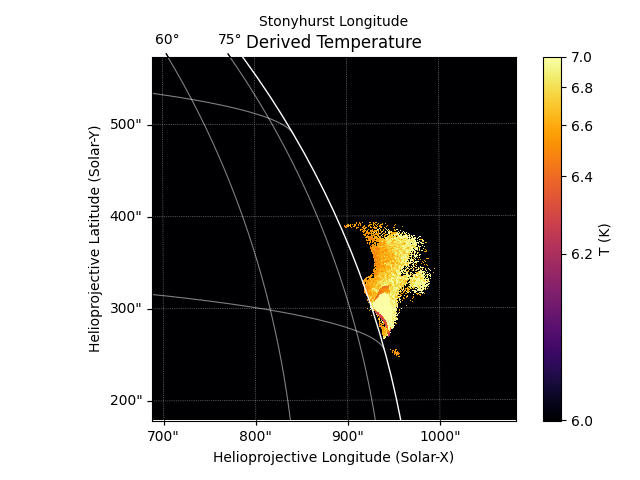
The output is a namedtuple with attributes Tmap, EMmap, Terrmap, and EMerrmap.
As with the SolarSoft IDL routine xrt_teem.pro, the output images are logs of the quantities.
Tmap is the electron temperature, EMmap is the volume emission measure, Terrmap
is a measure of the uncertainties in the temperature determined for each pixel and EMerrmap
is the same for the emission measure.
T_e = T_EM.Tmap

fig = plt.figure()

ax = plt.subplot(projection=T_e)
T_e.plot(
    title="Derived Temperature",
    cmap="inferno",
    norm=ImageNormalize(vmin=6, vmax=7, stretch=LogStretch(10)),
)
T_e.draw_limb()
T_e.draw_grid()
plt.colorbar(label="T (K)")
plt.tight_layout()

plt.show()
If you want to do the same for Level 2 synoptic composite images, you have to use
make_exposure_map to generate the exposure maps for the composite images.
This is then passed to xrtpy.response.temperature_from_filter_ratio as the
expmap1 and expmap2 arguments.
Otherwise without accounting for the different exposure time per pixel,
the temperature and emission measure will be incorrect.
Total running time of the script: (0 minutes 7.105 seconds)